





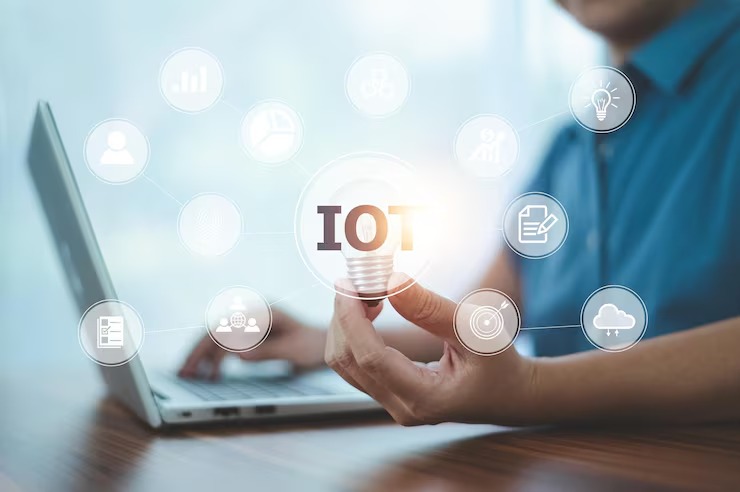
What is an IoT ecosystem and its relevance in today’s world? Without the Internet of Things (IoT), modern-day comforts like automatic car navigation and intelligent home automation would not exist. The Internet of Things, or IoT ecosystem, is a network of physical systems and gadgets that might revolutionize how people work, play, and live.
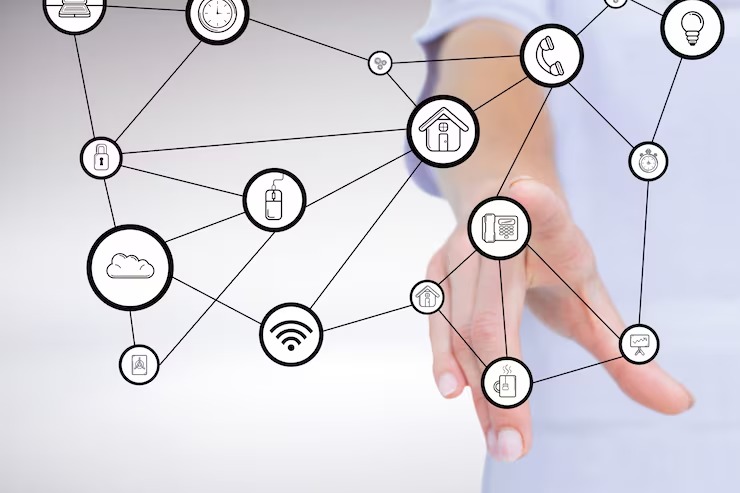
But the Internet of Things is not a single, uniform thing. It encompasses a vast array of technologies, each with distinct advantages and disadvantages. In this article, you will understand what the Internet of Things, the IoT ecosystem components, and the challenges of IoT systems. Without further ado, let’s get started.
What is an IoT Ecosystem?
What is the Internet of Things? The Internet of Things refers to the network of physical objects, systems, and information linked to the Internet. If that isn’t the IoT ecosystem definition you might be thinking, you can see IoT as a network of linked sensors and devices, the cloud, and the data that moves between them.
IoT makes it possible for devices to transmit data to the cloud for analysis and action. This enables machines to function autonomously without requiring human input.
The manufacturing, healthcare, and transportation sectors have all seen radical changes because of the IoT. Though the Internet of Things has great potential, there are several shortcomings in its current state.
Smart thermostats, self-driving vehicles, speakers, and refrigerators are just a few of the items that make up today’s Internet of Things. More creative architecture, remote health monitoring, and more efficient transportation systems are just a few of the amazing new experiences IoT makes possible. Additionally, it produces a lot of data that must be examined to be utilized in decision-making.
How Does the IoT Ecosystem Work?
With a clear understanding of what is an IoT ecosystem, you should know that IoT devices essentially take information from their environment or human inputs, then evaluate that information. In the first place, sensors gather environmental data. It could be a single sensor or a group of sensors (referred to as devices).
They gather the information, which is then utilized. Examples of sensors (devices) include temperature sensors, GPS, and LDRs. After that, the sensor sends the data it has acquired to the cloud through a link. These connections can include satellite, Bluetooth, LAN, Wi-Fi, and more.
The software examines and evaluates the data in accordance with the program that is written in it after it has reached the cloud. Prediction-making data processing is usually part of this. Processing any image, reading meteorological conditions, and reading temperature measurements are a few examples of data processing.
Sending the user this information is the most crucial step in this procedure. Making a user inference and displaying the processed data to the user will accomplish this. This involves informing customers about the weather and when the temperature rises, among other things.
Components of IOT Ecosystem
There is no better IoT ecosystem definition than it is a network of linked things, devices, and even people who collaborate to gather, exchange, and act upon data. It resembles a vast network of interconnected objects that communicate with one another to accomplish a shared objective. The following are some essential elements of an IoT ecosystem:
Sensors (Devices)
A vast array of sensors make up Internet of Things devices. Sensors can be as complicated as a self-driving car or as basic as a button. Multiple sensor types can be found on a single device, and they can cooperate to carry out a single task or a series of tasks. For instance, the iPhone 5s contains a fingerprint scanner, light sensor, proximity sensor, and accelerometer that are all linked to the device’s application processor. As a result, more sophisticated features like Touch ID identification and sophisticated gesture control are possible.
Connectivity (Network)
An Internet of Things device’s capability for interaction with the Internet is one of its distinguishing features. The quality of your network determines the capabilities and performance of your IoT devices. You can connect IoT through a wired or wireless connection.
- Wired Connection: A wired connection is the most fundamental kind of network. With several devices linked to the same network, wired networks offer a dependable connection and are comparatively quick. The simplest IoT devices usually employ wired connections, which are suitable for areas that do not encourage wireless development.
- Wireless Connection: Cellular connection is the most often utilized kind of connectivity among IoT devices. Most places in the world have strong coverage and dependable cellular service. But it is also rather pricey, with cellular data rates costing far more than wired internet options.
User Interface
Either on-device or on a networked platform, the user interface is the last element in an IoT ecosystem. Every IoT ecosystem has some kind of user interface that enables people to communicate with the device and the data it collects. It demonstrates how to use Internet of Things devices via buttons, touchscreens, or applications.
Humans and gadgets communicate using a variety of inputs, such as buttons, touch screens, speech recognition software, etc., and outputs, such as lights, speakers, digital readouts, etc. This also includes so-called virtual user interfaces (VUIs), in which standard visual cues are replaced by written instructions or aural feedback to provide an output that is not visible but exists in software form. Normally, you will need an IoT partner ecosystem to get a complete IoT solution.
Benefit of IoT Ecosystem
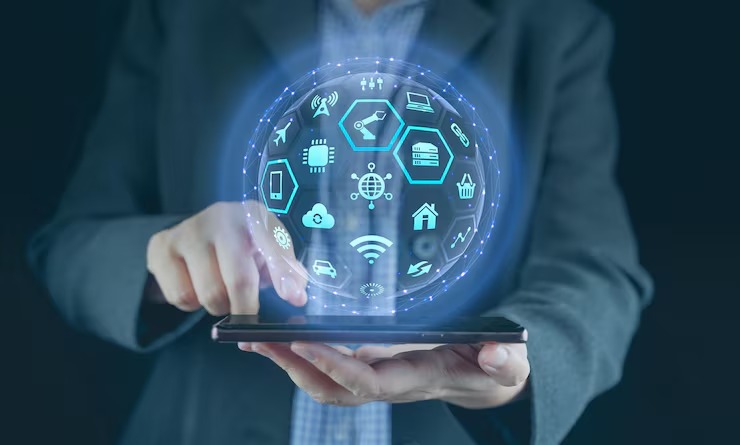
IoT ecosystems have the potential to provide value and greatly benefit organizations. A better understanding of the benefits of the IoT ecosystem will provide a clue to how important it is for our daily lives.
New sources of income
There will be a chance to provide new services based on improved insights that were not previously required as IoT technology advances. Many companies, including telcos, will have a completely new source of income thanks to these IoT products.
Increased effectiveness
Businesses may increase efficiency by automating and simplifying operations with the help of an IoT ecosystem. The workforce becomes more productive as a result. You can do more tasks more quickly with fewer resources and a lower risk of human mistakes when procedures are more automated and simplified.
Novel business strategies
With automation and new service offerings, IoT is working to develop new business models. Now that the IoT ecosystem is in place, company operations are improving.
Improved decision making
You may obtain real-time data, analytics, and insights that can be utilized to enhance corporate operations, as well as product and service offerings, thanks to the IoT ecosystem’s rapid operation. Consequently, the consumer experience is enhanced.
Challenges of IoT System
Though IoT is an emerging technology, a few challenges must be addressed before it is widely adopted.
The vulnerabilities of cyberattacks
Using networks and computers to hack into people’s PCs and data has become simpler over time. Hackers can gain access more easily to bigger IoT networks. Hackers typically employ these gadgets to compromise networks or steal user data.
Being a network of linked devices that are always in operation, the Internet of Things system is a prime target for hackers. Technical knowledge of the IoT ecosystem can make hacking into all these networks easy.
Privacy
One of the biggest problems with IoT devices is privacy concerns. Devices connected to the Internet of Things run the danger of transmitting private data. You need to verify that the data encryption is working properly. Because of its rapid expansion, the Internet of Things presents privacy and security issues. Your desktop or laptop’s IoT gadgets raise the risk of data breaches while they gather and send data.
Technology Controls Life
IoT has affected practically everyone’s life in every manner possible. For everyday chores, both younger and older generations have become dependent on technology. With IoT, this reliance will become even more prevalent in day-to-day tasks. No technical application is flawless; all have their share of problems. If an IoT infrastructure malfunctions or breaks, relying on IoT devices may become troublesome.
Conclusion
If you know what is an IoT ecosystem, it is important to understand that the elements of the IoT ecosystem have the potential to improve productivity and corporate operations when properly deployed. This is accomplished by automating procedures, managing and storing vast volumes of data, and providing access to crucial data insights and analytics. We anticipate that more companies will adopt an IoT strategy in the next few years to meet the increasing demand for new business and consumer products.